Node0 Is Online
51 machines. 572 cores. 1.7 petabytes. The sovereign foundation is running, and it was built storage-first on purpose.
The hardware that waited isn’t waiting anymore.
Oznog Node0 is online. Racked, wired, powered, and running in a basement in Eden, Utah. Online is the honest word: the machines are up and the network carries traffic. Fully configured, monitored, backed up and documented is a different thing, and that work starts now.
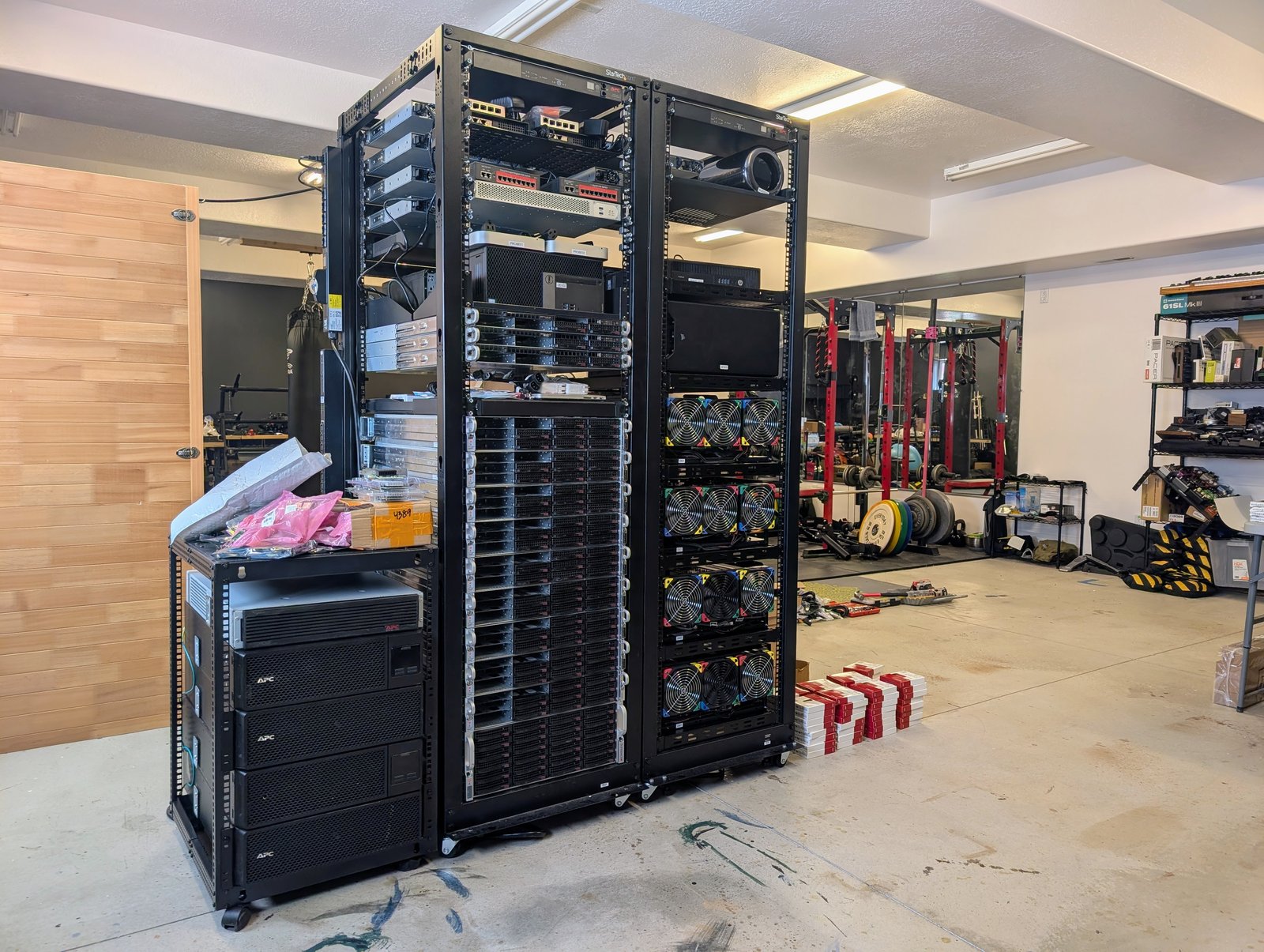
The numbers, for the techies: 51 machines. 572 CPU cores. ~9.6 TB of RAM. ~1.7 PB of raw storage across HDD, SSD, and NVMe. 8 NVIDIA GPUs with 148 GB of VRAM, plus Apple silicon with 256 GB of unified memory. An 8 Gbps fiber connection. Redundant switching, redundant firewalls, redundant power paths.
Storage-first, on purpose #
Anyone looking at those numbers will notice the shape: heavy on storage and standard compute, comparatively light on GPUs. That’s not a budget accident. It’s the design.
Data is the foundation, and it doesn’t depreciate. The relational maps, the archives, the collaboration history, the things worth holding sovereign: those need storage, redundancy, and careful custody for decades. GPUs, meanwhile, get dramatically better and cheaper every generation. So the foundation gets built first and built solid, and the DI compute gets staged in as the work demands it.
The staging path is already provisioned: the DI servers can take RTX 6000s as workloads grow, and there’s rack space, power, and transfer-switch capacity waiting for fully loaded Mac Studios and DGX Sparks when the next generations land. The skeleton is sized for the body it will grow into.
What Node0 is for, honestly #
Node0 is built for development, incubation, and pre-production. It runs on one fiber line and battery backup, not dual ISPs and a generator. Production workloads belong on infrastructure with those guarantees, and that’s a later chapter of the node network story.
What it gives us now is the thing that matters most at this stage: a sovereign place to build. Development environments, DI workloads, data custody, and spare capacity to incubate aligned projects alongside our own.
Connected sovereignty #
Sovereign doesn’t mean isolation. It means choice.
The pattern I keep recommending to every mission, community, and company I talk with: decide deliberately what’s worth hosting, maintaining, and trusting internally, and what to leverage from the frontier where it makes a meaningful difference. The terms of external access keep shifting, in price, in policy, in who’s allowed to connect. Internal capability isn’t paranoia. It’s negotiating position and power. Choice.
Node0 is what that pattern looks like when you commit to it in hardware.
What builds on it #
The first project building on Node0 is Standpoint Labs , which just went through its own realignment: relational infrastructure for the people and communities that need it most. That story is told over there .
And incubation applications are open: the founding cohort begins Q4 2026, aligned builders working from Node0. If you’re building something that fits the fifth story , apply here .
Infrastructure is the foundation. How it’s used and what’s built on it are what make the difference.
Postscript, 20260921: this post was written in June and published in September. Node0 was online on 20260630 and production-ready on 20260913, and the difference is most of the runbooks, the alert rules, the backups proven by restore, and the inventory brought to match the racks. The counts above are the June counts; the current ones are on the Node0 pages .