
Storage
Four tiers that each cover a different way to lose data, and the nightly habit that proves they work.
916 TiB Ceph raw · 493 TiB hub pool · 171 OSDs on nine hosts
What this layer is for #
Storage is where Node0 keeps everything that must survive a reboot, a drive failure, a whole-home event, or Christoph’s own mistakes. Those are four ways to lose data, and no one box covers all four. So the layer has four tiers.
- A hub. unraid1 is the local disk shelf: five ZFS pools, 493 TiB (542 TB) raw on the bulk pool, and the place the fleet’s own backups land.
- A replica. nexus holds a second on-site copy of 58.2 TiB (64 TB), and will eventually leave the property.
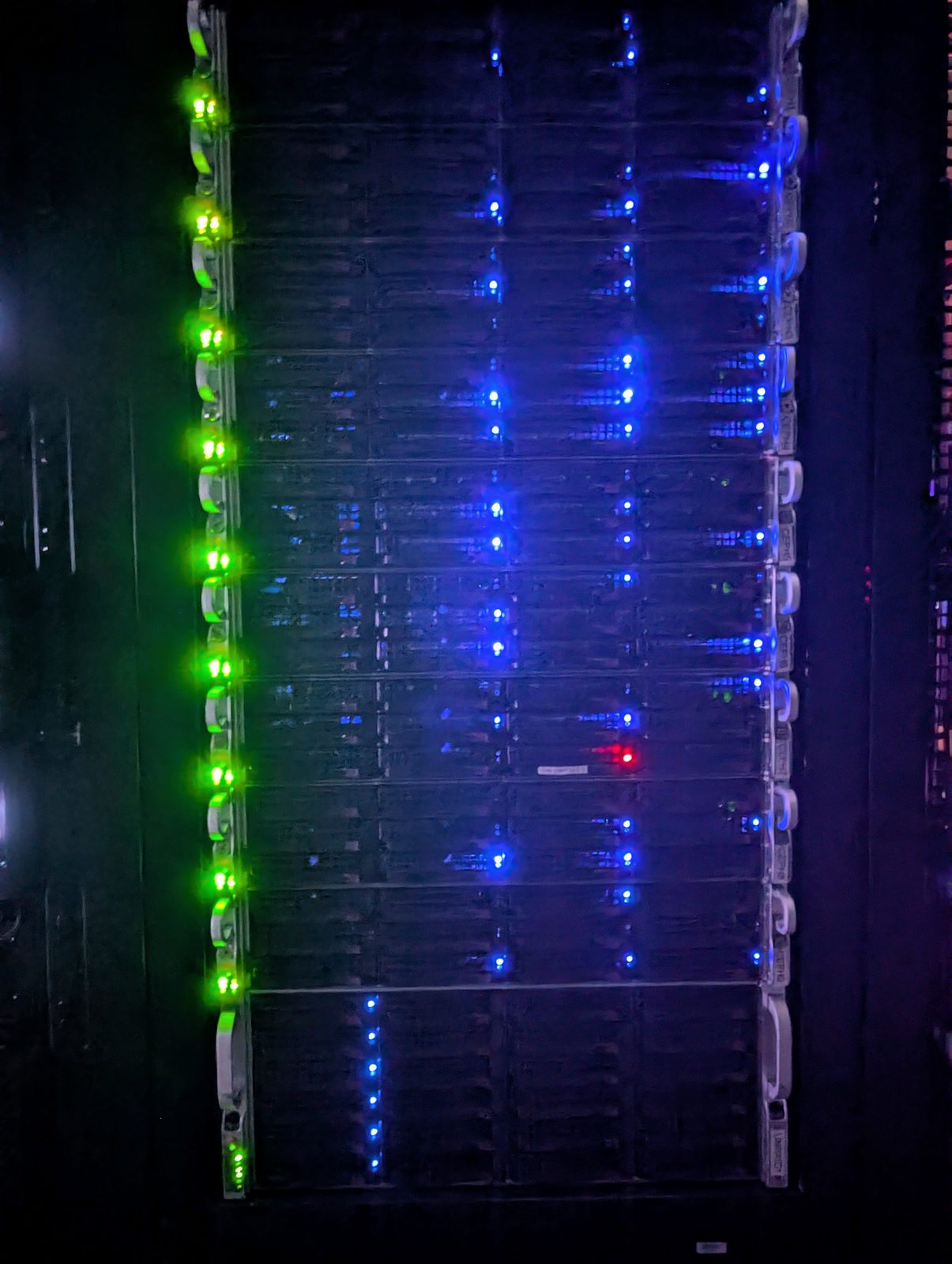
- A cluster. ceph1 to ceph9 hold 916 TiB (1,007 TB) raw across 171 OSDs, and serve block, object and file storage to the rest of the site.
- Two escape hatches. An offsite bucket on Backblaze B2, and two rotating offsite USB drives of about 23.5 TB each.
A fifth part of the layer is a habit rather than a place. Every night the site takes snapshot-consistent backups and checks that every restic repository is still receiving them, and every week it rehearses a restore, because a backup nobody has restored is a belief.
Until the summer of 2026 all of this was one box, nexus, which also held the docker fleet, the DNS resolver and the only copy of years of photos. On 20260821 Christoph ruled that everything moves to a new hub, unraid1.
How it is built #
unraid1 runs five ZFS pools. tank is 493 TiB raw across three 10-wide raidz3
groups, with a mirrored NVMe metadata device and an Optane write log. fast is
a mirrored NVMe pair for container state. ssd is six SATA SSDs in raidz2 for
photos and studio work. local and flash sit on the boot SSDs. A live read
on 20260921 found 53.8 TiB allocated on tank, and all five pools ONLINE with
no errors.
nexus is unraid1’s pull replica. Every hour it receives a one-way encrypted ZFS stream of a chosen 31-dataset subset. It is not a mirror, because unraid1 holds far more than nexus can carry. On 20260921 it was ONLINE with 26.4 TiB used, and its last scrub, on 20260915, found nothing.
Ceph is nine hosts and 171 OSDs, where an OSD is one daemon that owns one disk. It holds 916 TiB raw: 794 TiB of HDD, 65 TiB of SSD, 57 TiB of NVMe. On 20260921 the cluster reported HEALTH_OK with 43.2 TiB used, 17 pools, and every placement group active and clean. It serves S3, CephFS with Samba and NFS gateways, iSCSI, NVMe-over-TCP, and the Proxmox cluster’s shared VM pool. Ceph and unraid1 are separate on purpose. Neither is built on the other.
Raw capacity is not usable capacity. Divide each tier by its own protection scheme before planning against it, because the schemes differ inside one cluster. Here 5+2 erasure coding returns five sevenths of the HDD tier, the flash pools are three-way replicated and return a third, and the two together come to about 608 TiB usable. That is arithmetic from the pool layouts on 20260921, not a tested fill. Across the three tiers together the usable figure on 20260922 was 987 TiB (1,085 TB): the 608 on Ceph, 338 on unraid1’s five pools and 41 on nexus, the last two read as used plus available from ZFS. Every disk in every one of the 71 hosts, the boot drives and the Pis’ cards included, adds up to 1,606 TiB (1,766 TB) across 356 disks; the storage tier is 95% of it.
| host | role | rack | OS |
|---|---|---|---|
| ceph1 to ceph9 | Supermicro 2U, 19 OSDs each; monitors, metadata servers, gateways | 2 | Debian 13, Ceph 20.2.4 |
| unraid1 | the hub: containers, five pools, fleet backup server | 2 | Unraid 7.3.2 |
| nexus | encrypted pull replica | rack 0 | Unraid 7.3.2 |
| nexus-spare | spare chassis, unpopulated | shelf | not deployed |
| ceph-backup1 | backs CephFS up to the hub | 2 | NixOS guest |
The backup flow #
The drawing above is the shape. What follows is the schedule.
Laptops and agent hosts back themselves up every two hours to an append-only restic server on unraid1. unraid1 backs itself up from a frozen view. At 02:50 an orchestrator takes one atomic ZFS snapshot per pool and bind-mounts it read-only before Backrest reads a byte. If that snapshot is missing, stale or partly built, the orchestrator refuses to run.
Two runs read from that view. One writes the small irreplaceable tier to the offsite bucket at 03:00. One writes nearly all of unraid1 into a bucket on the site’s own object storage at 04:00, which is a second local copy in a different failure domain. A third flow does not need that view at all: at 02:00 syncoid sends ZFS snapshots to whichever offsite USB drive is attached, mirroring the source’s own snapshot set, and a ZFS snapshot is consistent by construction. Two flows run on their own clocks: unraid1 sends hourly encrypted snapshots to nexus, and a guest backs CephFS up into the restic server, so the 12 TiB archive of model weights has a copy outside Ceph.
One script is the sole writer of the two managed plans. Every night it checks the live configuration against its own specification, and it refuses to run if the two differ.
The invariant #
One rule covers every flow above. A destination never holds a backup that originated from itself. A copy that lands inside its own source dies in the same event it exists for. The plan that backs unraid1 up into Ceph excludes Ceph’s landing zone on unraid1, in code. The Ceph identity bundle goes to the offsite bucket and the USB drives, never back into Ceph. The archive of model weights goes from CephFS to unraid1, never the other way. The generator that writes the plans enforces the rule, so nobody has to remember it.
The three checks #
One check cannot cover a backup, because arriving, coming back and still being sent are three different failures. Three checks answer three questions here, and none of them trusts the others.
Does a repository still receive snapshots? A daily verify sweep answers that, moved from core2 to util2 on 20260830. Does the data come back? A weekly restore test restores a few files from each of three repositories and checks each one’s size against the snapshot. Is the ZFS replica still receiving sends? A third check on util2, added 20260914, answers that.
What is covered, and what is not #
unraid1 is the single point of failure for everything that is not also on Ceph,
nexus or offsite. It has redundancy inside itself, since raidz3 tolerates three
drive losses per group, but none against the loss of the box, the room or the
home. On 20260915 the inside redundancy did its job. A tank drive died hard
in the middle of a scrub, the pool stayed ONLINE on two parity disks, and the
replica stayed current through the swap.
Ceph tolerates the loss of a full host by design. One tier of raw, regenerable datasets on it has no backup, by policy. Losing nexus costs nothing irreplaceable. Losing either escape hatch costs the only off-property copy of a few things, most importantly the archive, for the reason in the third decision below.
The Seed starts this layer at rung 0 , a laptop whose backups already run to a bucket, and the Seed design’s backups keep the same rule that a destination never holds a backup of itself.
The decisions #
20260903: 5+2 erasure coding, host as the failure domain #
Workload. Bulk object and file storage for the site, plus block storage for the Proxmox cluster’s virtual machines.
Requirement. Real capacity out of 72 spinning disks, while keeping the ability to lose a whole host.
Choice. 5+2 erasure coding on disk, with the host as the CRUSH failure domain. CRUSH is Ceph’s placement algorithm, and the failure domain is the unit it will not place two shards inside. The database and write-ahead log sit on dedicated NVMe. Block pools stay three-way replicated on NVMe for latency.
Accepted trade-off. 71% efficiency and slower small writes, against three-way replication’s 33%.
Verified. Total power loss and a disk replacement in a lab on 20260816, before any production disk. All three lab nodes were killed at once, and quorum reformed unaided in about 90 seconds. The cluster itself was bootstrapped at 19:10 on 20260903 and complete at 21:20.
20260905: the recursion rule, and a frozen view #
Requirement. Backups that cannot become copies of themselves, and cannot catch a live database mid-write.
Choice. The invariant above, enforced by the plan generator, plus Backrest reading only a frozen snapshot and failing closed.
Accepted trade-off. The configuration is generated and never edited, so a hand edit stops the backup instead of changing it.
Verified. Two Codex review rounds closed fifteen findings the same night, most of them of the shape “a failure here would look like success”. The drift refusal fired for real on 20260909.
20260818: what goes offsite, and what does not #
Requirement. An off-property copy of everything irreplaceable, inside a monthly budget.
Choice. The irreplaceable-and-small tier goes to the offsite bucket nightly. The largest and oldest material rides the two rotating USB drives instead: the archive, the fleet’s backup repositories and the Ceph identity bundle.
Accepted trade-off. The archive has exactly one off-property copy, and it is a drive somebody swaps by hand. Putting it in the offsite bucket was costed at roughly $70 a month and deferred.
Verified. The capacity review of 20260818 produced the number and the decision together.
What it cost #
Replacement costs are not yet researched, and purchase prices are not published. The bill of materials of 20260920 lists nine Supermicro 2U storage nodes, one 4U chassis and two 8-bay desktop units.
What broke #
- Lesson 3.17 , Editing the config by hand took out both nightly backups at once. A hand edit on 20260909 disabled both plans. That is why the generator now refuses to run on drift.
- Lesson 3.16 , The bucket that was declared purged and wasn’t. A bucket noted as purging in the background had no rule to make that happen. 9.97 TiB across 614,000 objects sat there for at least six days.
- Lesson 3.21 , The second storage tier nobody was writing to. The VM backup datastore held one archive and the cluster had no backup job, while every server-side check ran green.
- Lesson 3.18 , The PG autoscaler that silently did nothing, because two rules quietly overlapped. Ceph will not act on a pool while CRUSH roots overlap, and says nothing when that happens. The fix moved roughly 27 TiB in seven hours.
State on the day #
Healthy on 20260920. Ceph reported HEALTH_OK across nine hosts and 171 OSDs, with all 2,497 placement groups active and clean. All five of unraid1’s pools were ONLINE with no errors. The replica was 45% full and had scrubbed clean on 20260915. The nightly plans were on a confirmed live schedule, and the three checks were in place on util2.
Closed on the capture day, and marked as such. The VM backup datastore was given the nightly guest job it had never had, told on the agents page . Also that day, the offsite bucket moved to a 30-day hidden-version retention rule, and the NVMe controller watch on ceph8 closed after 243 hours clean.
Open on 20260920. A second NVMe controller wedge on ceph2, seen 20260917, is under a watch with a date to recheck. The spare parts inventory is a partial record, by decision. RMAs are waiting to be processed. Monitoring will be refined as the hardware burns in. The question that would have caught the empty datastore a fortnight earlier is now in the backup runbook, and it is “how old is the newest thing in it, per source”, not “are the jobs green”.
Source: node0 as-built v0.1, section 3.5. Sanitized: checklist v0.1, 20260921. Capture of 20260920; the private site keeps changing, this page does not. Part of oznog.com/node0.