
Site
The container every other layer runs inside: two rooms, four racks, the cable plant, and the conventions that find one thing among many.
185 active devices · 4 racks in 2 rooms · 407 cables, 270 carrying a colour
What this layer is for #
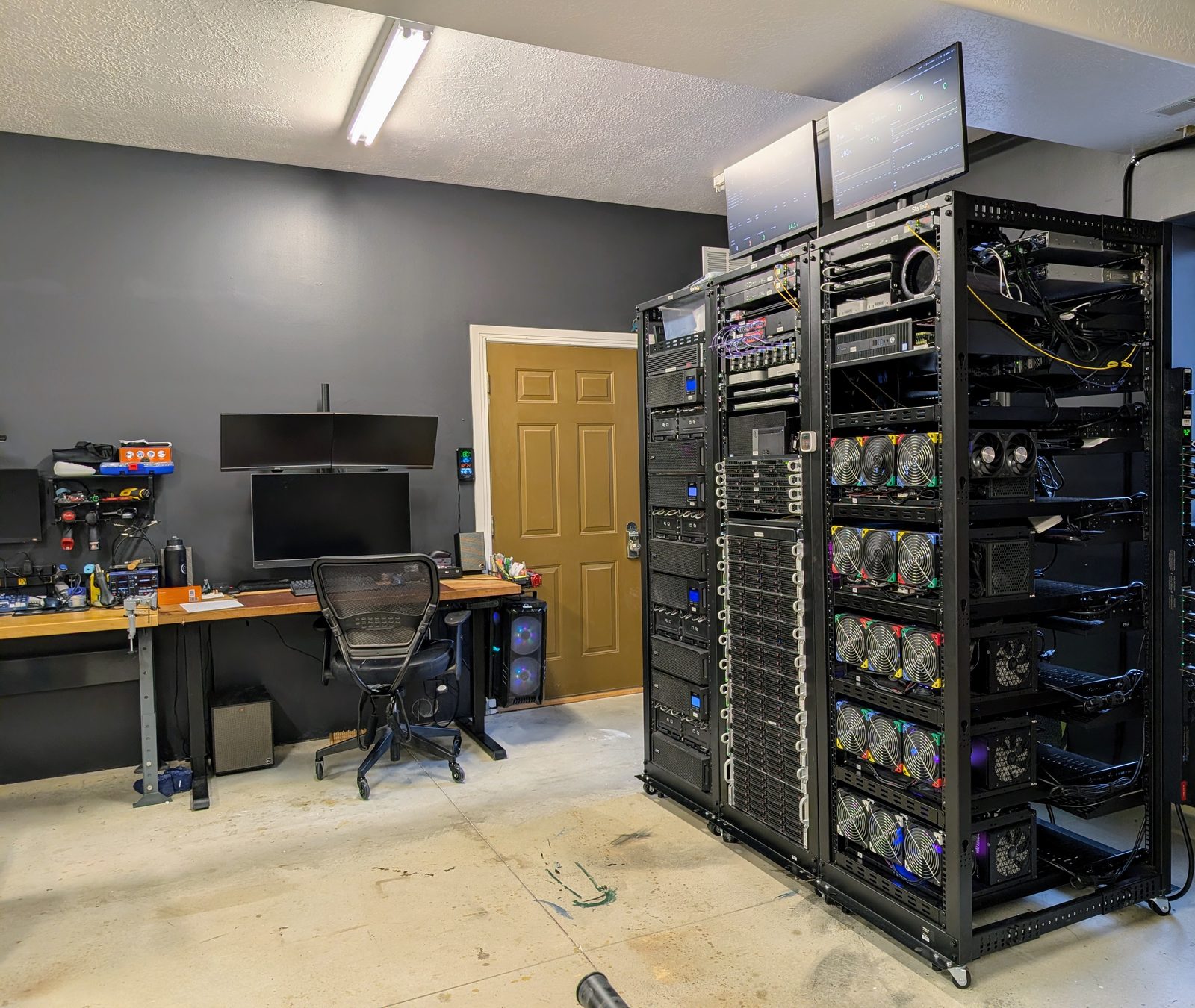
Every other layer in this capture describes something that runs. This one describes the container they run inside. Two rooms of a home hold four racks, the cable plant, and the naming and labelling conventions that let a person or an agent find one thing among 185 active devices without walking the room twice. The layer has no hosts of its own. It is where the hosts are.
The inventory export of 20260920 counts 185 active devices of 191 recorded, the other six being four hardware spares and two ledger entries. It counts 7 virtual machines, 407 cables, 31 IP prefixes and 22 VLANs, 19 of them active and 3 reserved.
71 of those devices are hosts, by the rule adopted on 20260921: every active
device that runs an operating system we operate, counting the Pi and cluster
nodes and the small utility hosts, and leaving out personal laptops, the consumer router, the rack displays, the console server, the
offsite dock and anything offline. 69 of the 71 stand in these two rooms; one
is a canary at a second home nearby, and one is a rented instance in another
country. Across the 71 the fleet has
1,235 threads / 735 cores and about 8.4 TiB of memory, read on 20260921 over ssh (cores on 20260922) with
nproc and MemTotal on the Linux hosts and hw.ncpu and hw.memsize on the
Macs, with the four Windows and firewall hosts taken from Christoph’s record of
the same day. The seven hypervisor guests sit inside the hypervisor figures and
are not counted again.
The Seed is the pattern at its starting size, a few small boxes; Node0 is the same pattern at four racks, reached in one basement in the first days of September 2026. The ladder runs both ways. nexus stopped being the central server when unraid1 took that role, decided 20260821, and is planned to leave the site. Hardware graduates in, does the central job, and graduates back out.
How it is built #
The network room is a closet off the server room with its own air conditioning, and it holds rack0 (12U), the spares shelf and 23 devices. The server room holds racks 1, 2 and 3, 42U each, and 142 devices. The home side of the building connects one way. It can reach into Node0, and Node0 cannot reach back.
44 of the inventory records are this layer’s own, and not one of them is a host: shelves, cable management, fans, displays, a transformer, a crash cart, four receptacle circuits and two parts ledgers. Carrying a circuit or a ledger as a device makes what plugs into which circuit, and where a part went, records rather than memories.
| rack | U | role | grounding |
|---|---|---|---|
| rack0 | 12U | network closet: internet ingress, fw1/fw2, sw-wan1, ntp1, nexus, home-side gear | not bonded (deliberate) |
| rack1 | 42U | UPS and battery: ups1 to ups4, two packs each, the step-down transformer | bonded 20260912 |
| rack2 | 42U | infrastructure and storage: ceph1 to ceph9, prox1 to prox4, unraid1, core1/core2, the Pi clusters, dev1 to dev4 | bonded 20260912 |
| rack3 | 42U | compute, inference, dev: di1 to di5, the agents, util1/util2, the sandboxes | bonded 20260912 |
Rack fill by occupied U, from the same export: rack1 93%, rack2 100%, rack3 98%. Rack 2 is full in the plain sense. Rack 3’s figure is the inventory’s, not the room’s: its shelves count as occupied units, but they were placed to hold the compute that is still to come, behind the GPU hosts and on the shelf at U31, which is why transfer-switch ports there sit free. By Christoph’s estimate rack 3 is about two-thirds full in the sense that matters. An inventory models a shelf as a device, not as room. Rack0 has no fill figure, because its devices sit on one labelled shelf with no individual rack positions in the record.
The racks were filled with pulled enterprise gear, ex-datacenter and bought used. The first batch was thirteen Supermicro chassis: three one-unit, nine two-unit, and one four-unit 36-bay machine, which is unraid1. A fourth one-unit hypervisor, prox4, was ordered on 20260903 and joined afterwards. Bring-up ran 20260901 to 20260903 and is the source of most of the site’s physical discipline. All thirteen boards of that first batch are ex-hosting-provider pulls carrying a signed OEM BIOS locked at 3.2a that the vendor’s own updater refuses to flash, proven on ceph7 on 20260903. One replacement board arrived unlocked, so Node0 re-applies its own settings file to whichever BIOS a board carries rather than chasing version parity.
The cable plant #
The export of 20260920 counts 407 cables, 270 of them carrying a colour from the standard Christoph set on 20260913, whose legend, ambiguity and back-fill are on the fabric page .
What takes the site down #
Two things take the whole site down: loss of the building, and the electrical panel and the circuits feeding the racks. Water is watched but is not on that list: the portable air conditioner’s drain has a sensor on it for early notice, and there is far more floor than water, so a leak there is a cleanup, not an outage.
A rack that holds almost no compute can still be the fleet’s single point of failure, because orderly shutdown depends on power. Rack1 is that rack here. Losing it removes the power buffer racks 2 and 3 draw on during an outage. Rack0 is a second single point of failure, as the only rack holding the firewall pair, the WAN switch and nexus, and the only rack not bonded to ground. If the site goes, everything goes, apart from three deliberate exceptions where a recovery would start: the rented instance elsewhere, the offsite bucket, and the rotated drives.
The decisions #
20260903: label everything, before the box goes in the rack #
Workload. Thirteen pulled chassis into four racks in three days. Requirement. Any cable or device identifiable by whoever did not remove it, an agent working from a description included. Choice. Label everything, front and back, at every U, and both ends of every cable. Accepted trade-off. Slower bring-up, and every move means relabelling. Verified. By the faults it did not prevent. About half the human-caused faults of bring-up traced back to an unlabelled cable put back wrong, and a label taken on faith was wrong three times over three weeks (lesson 5.2 ).
20260912: bond racks 1 to 3 to building ground, and leave rack0 out #
Workload. Three racks of powered equipment and a UPS wall in a basement. Requirement. Rack frames bonded to the building’s electrical ground. Choice. Racks 1, 2 and 3 bonded, rack0 excluded, the network closet judged low-risk by comparison. Accepted trade-off. One rack in four is unbonded, and it is the one holding the firewall pair. Verified. The reasoning went into the rack records the same day, so it reads as a scope decision and not an oversight. No electrical test result is recorded.
20260916: three axes for a part, not one #
Workload. Spares and retired parts moving between shelf, chassis and return shipment. Requirement. Knowing whether a part is actually available. Choice. Parent device, status and disposition on every part, instead of one status field. Accepted trade-off. Three fields to keep right, and the spares shelf stays a partial record by decision. Verified. Adopted after five already-claimed drives read as available stock.
20260920: model the studio before the wall exists #
Workload. The music and content-creation gear at one end of the server room, intended to become a separate room once a wall goes in. Requirement. The record describes intent, so the eventual partition is a wall being built rather than a database migration. Choice. Model Node0 Studio as a location now, ahead of the wall. Accepted trade-off. Record and room disagree until the wall exists, which is a documented disagreement rather than drift. Verified. Partly; see the state below.
What it cost #
Replacement costs are not yet researched, and purchase prices are not published.
What broke #
- Lesson 1.1 , “What thirteen pulled servers actually cost.” Three working days on site, plus 3 of about 80 refurbished, never run 12 TB drives dead on arrival, 1 of 3 RAID cards, 5 of 13 CMOS cells and a damaged riser slot.
- Lesson 1.2 , “Board damage an elimination tree cannot see.” One host needed three motherboards in nine days, and the first fault was visible only with the board out of the chassis under bench light.
- Lesson 1.5 , “Identity lives on the drive or the card, never the board.” On two families of single-board computer a board swap cost nothing, because hostname and configuration follow the storage. Nobody could say afterwards which board went where.
- Lesson 5.2 , “Two labels, corrected three times, before anyone traced a cable.” Which supply fed which rack power distribution unit was wrong or uncertain for three weeks, and was settled on 20260909 only by walking the cables one at a time.
State on the day #
Healthy on 20260920. Four racks standing, racks 2 and 3 full, racks 1 to 3 bonded, the colour standard set and back-filled, the bring-up traps written into runbooks rather than left in an agent’s memory, and the inventory holding 185 active devices and 407 cables as that morning’s export recorded them.
Open. The spare hardware and parts inventory is a partial record by decision, and closing it is on Christoph’s list of what remains before he calls Node0 stable. Current returns and replacements are still to be processed. A second wallboard host and the display for the top of rack 1 are not deployed, so one host drives the two displays above racks 2 and 3. Several records lag the room: the studio location, the thermostat, and the home-side edge gear the cable back-fill found missing.
Closed on the capture day, and marked as such. One cable recorded as cat6 was found to be cat6a and corrected on 20260920. The studio location’s loaders were written the same day, after the export this page reads, so the location exists as a decision and as code but not yet in the data quoted here.
Source: node0 as-built v0.1, section 3.1. Sanitized: checklist v0.1, 20260921. Capture of 20260920; the private site keeps changing, this page does not. Part of oznog.com/node0.