Fabric
The switches, VLANs and bonds that decide what can reach what inside Node0.
6 Arista switches · 19 active VLANs · 135 addressed devices migrated in a day
What this layer is for #
The fabric is Node0’s data plane: the switches that move packets between racks, the VLANs (virtual LANs, separate broadcast domains carried over the same wires) that keep one purpose’s traffic away from another’s, and the bonding conventions that let a host survive losing a switch. It sits between the edge, the boundary to the internet, and every host that plugs into a rack. Storage, compute, services and the agents all sit on top of whatever the fabric decides is reachable.
Before 20260818 there was no fabric. Node0 ran flat, one broadcast domain behind a consumer router. Ceph’s public and cluster networks, the management plane, the DMZ (the segment for internet-exposed services) and the internal service tier all wanted separate wires. A flat network had none to give.
How it is built #
Six Arista DCS-7050TX-64-R switches carry the data plane as three MLAG pairs. MLAG (multi-chassis link aggregation) lets two physical switches present themselves to a host as one, so a host’s two uplinks become a single bonded link across two boxes. The drawing shows the three pairs and which of them routes.
All routing lives on Pair A. Eleven VLANs take their gateway from VARP (virtual ARP, Arista’s active-active scheme in which both switches answer for the same gateway with the same virtual MAC, so east-west traffic never crosses the peer link). The rest are trunked to the firewalls. Pair B does not route. It serves the compute and dev racks and reaches everything else over a 160 Gbps back-to-back port-channel to Pair A. The third pair is a Ceph backend island with jumbo frames and no gateway at all, so cluster replication never leaves it.
Every regular host attaches by a single LACP bond (link aggregation control protocol, which negotiates two ports into one logical link), both members on one MLAG pair, never split across pairs. The management switch is the one deliberate exception. It is dual-homed to both pairs with spanning tree blocking one path, so a bad push to one pair cannot strand out-of-band access to the switches you need out-of-band access to fix.
| host | role | form | rack | OS |
|---|---|---|---|---|
sw-fa1, sw-fa2 | frontend Pair A, the only switches that route | Arista DCS-7050TX-64-R | rack 2 | EOS |
sw-fb1, sw-fb2 | frontend Pair B, layer 2 only | Arista DCS-7050TX-64-R | rack 3 | EOS |
sw-cb1, sw-cb2 | Ceph backend pair, jumbo frames, no gateway | Arista DCS-7050TX-64-R | rack 2 | EOS |
sw-mgmt1 | management and out-of-band switch, dual-homed to both pairs | Netgear S3300-52X-PoE+ | rack 2 | vendor firmware |
sw-wan1 | transparent layer-2 bridge between the provider’s handoff and the firewalls | MikroTik CRS305-1G-4S+IN | rack 0 | RouterOS |
sw-rpi1, sw-rpi2 | power over Ethernet for the Pi cluster | STEAMEMO GPS208 v3 | rack 2, shelf | web-only firmware |
ap1 | the only access point inside Node0’s own network | OpenWrt One | rack 3 | OpenWrt |
sw-lan1, sw-studio1, sw-lab1 | unmanaged edge switches, no address, no management plane | YuanLey and Sodola 2.5GbE | rack 0 and unracked | none |
Two Arista spares and one Netgear spare sit unracked and unpowered. The inventory export of 20260920 counts 407 cables, 270 of them carrying a colour from the standard. The same export lists 22 VLANs, 19 of them active and three reserved as layer 2 while they wait for a gateway. Management has its own VLAN and its own switch. The VLAN-to-subnet table stays internal, so this page gives the shape and not the map.
The VLAN shape, without the map #
What can be shared is the set of segments and the rules that decided them; the tags and prefixes are the one thing on this page a reader has no use for and an attacker does. The segments are one per purpose and trust level: management, with its own switch; the Ceph back-end, an island with jumbo frames and no gateway; the storage front-end; the hypervisors and their guests; the agents and development hosts, on jumbo frames; a trusted wireless segment and a separate one for IoT devices; the probes; a bootstrap segment for network installs; a DMZ for internet-exposed services; a legacy segment that only shrinks; and the studio.
- Route where the policy lives. The fabric routes the segments whose problem is throughput, storage and compute, with VARP so east-west traffic never crosses the peer link. The firewalls route the segments whose problem is trust: the wireless networks, the probes, the DMZ. The general rule is that the higher-security segments route through the firewalls, where every packet between segments meets a rule, and the lower-security, high-volume segments route on the switches, so the firewalls never become the bottleneck for storage and compute traffic they have no reason to inspect.
- Give management its own switch, not only its own VLAN. A tag keeps traffic apart; a separate switch keeps the console reachable when the fabric itself is what is broken.
- A back-end that never needs a gateway should never get one. The Ceph replication segment has no route out, so a misconfiguration elsewhere cannot pull replication traffic across the firewalls or expose it.
- Declare a segment before it is used. Three segments exist on the switches as layer 2 with no gateway yet, waiting on a firewall interface. Reserving the tag and the name early costs nothing and stops the number being taken by something else.
- A bootstrap segment, with installs armed per machine. Network installs land on their own segment, and the install server answers only for a MAC address that has been armed for it, so a box that boots from the network by accident gets nothing.
- Renumber on paper first, then move hosts one at a time. Lesson 4.8 is the rule: documentation may run ahead of the live state, never the reverse, and a live address changes only at the moment its host moves. Lesson 4.9 is the day 135 addressed devices moved and the outage a stale switch entry caused.
- A vacated tag stays vacant. A number retired by a renumber is not reused while anything might still reference it, so a stale reference fails visibly instead of landing in the wrong segment.
- Wireless is a dumb access point on a trunk. The access point runs no DHCP, no DNS and no routing of its own; each SSID maps to a segment, and the fabric and the firewalls make every decision. Lesson 4.6 is what a default access point does otherwise.
The cable colours #
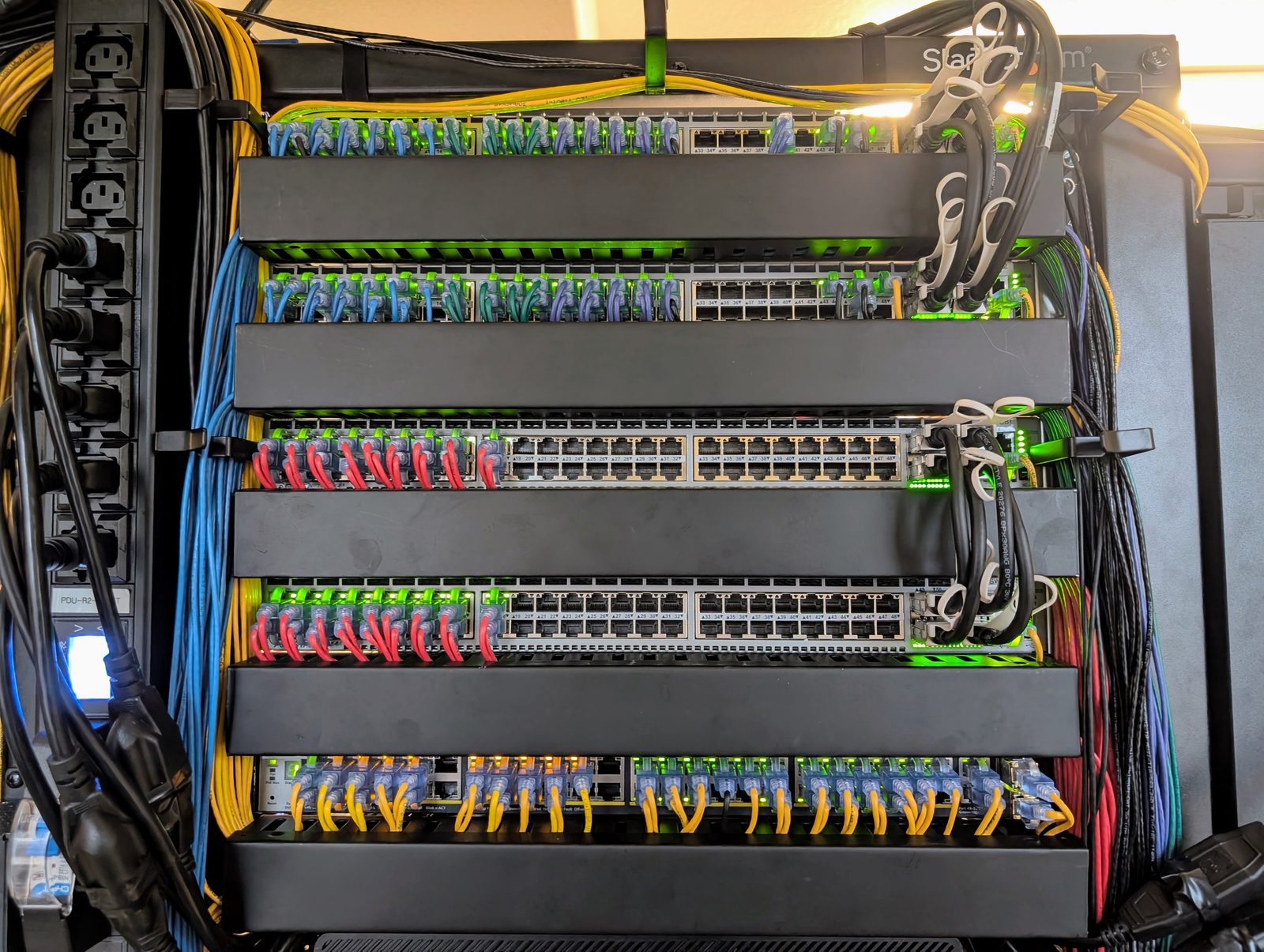
The legend is public, because a colour reveals nothing a label does not, and because it is the single cheapest piece of discipline on this page. One colour per purpose, chosen by Christoph on 20260913 and back-filled across every existing data cable the next day; new work only would have left the racks lying about their history for years.
| colour | what it carries |
|---|---|
| orange | firewall and internet |
| yellow | out-of-band management |
| red | Ceph back-end |
| blue | storage front-end |
| green | hypervisors and guests |
| purple | support: the access point, the Pi rigs |
| white | GPU compute and the agents |
| black | switch-to-switch interconnect, or any run the right colour was not available for at that length |
Black is the trap, and the reason the standard is descriptive rather than load-bearing. It carries two meanings, so a black cable is not evidence of its purpose, and tooling that reads colour to infer a role treats black as unknown. The colour is also recorded on each cable in the inventory, which is what lets a script check the racks against the standard; on 20260920 that was 270 of 407 cables carrying a colour from it, with the rest black, power, or not yet coded.
Failure domain. Losing Pair A takes the whole routing plane, because Pair A alone holds the transit link and every VARP gateway. Rack 2 also holds Ceph, Proxmox, the management switch and the DNS and NTP secondaries that were once split out for exactly this kind of redundancy, and Bosun’s guest runs on a hypervisor there. Losing rack 2 is close to a total service loss. Losing rack 3 costs the GPU hosts, the agents’ own machines and the utility hosts; the site keeps running without them.
The decisions #
20260817: MLAG pairs in-rack, and one bonding rule for every host #
Requirement. Survive one switch failing without a host losing its network, under one rule rather than a rule per host class.
Choice. Pair the two switches of a pair inside the same rack, not across racks. Give management its own VLAN and its own switch. Bond every front-end host port to Pair A whatever the host is. That last rule did not survive the build and is superseded: each host bonds to the pair in its own rack, so rack 3’s hosts, the GPU hosts, the agents’ machines and the access point among them, bond to Pair B.
Accepted trade-off. A rack-level loss takes both members of a pair, and load and risk concentrate on Pair A. Cross-rack pairing would have needed long 40 Gbps runs the existing cabling could not reach, for a benefit that does not help a host dying with its own rack anyway.
Verified. The assumption was re-examined against where the equipment physically sat and reversed the same evening. The failure domain that results is written down rather than discovered later.
20260818: the fabric built and live in one session #
Requirement. Three MLAG pairs, VARP gateways, the full VLAN set and cross-rack routing, without a multi-week staged cutover.
Choice. Build it in one multi-agent session on temporary addresses, then verify end to end before anything moved onto it.
Accepted trade-off. A long day with a large blast radius, against weeks of a half-migrated network running two sets of rules at once.
Verified. The VLAN set of that day, eighteen of them, was verified cross-rack before the session ended. Management addressing moved into a dedicated VRF (virtual routing and forwarding instance) after EOS refused an overlapping prefix, the kind of thing one session surfaces immediately.
20260827 and 20260828: renumber on paper, then migrate 135 addressed devices in one day #
Requirement. Move every online host onto segmented VLANs without a long outage and without breaking live services ahead of the move.
Choice. Renumber five VLAN identifiers and add two new ones on paper first, freezing every live address until its host’s own migration. Then migrate in a fixed order: a disposable test host first, the dependency hub next, then management, then everything else, and the DNS secondaries last so a resolver stayed up throughout. Almost every host kept its address and changed only mask, gateway and VLAN tag. Ten actually renumbered.
Accepted trade-off. That continuity left the numbering less tidy than a clean sheet would have been.
Verified. Executed against a written progress log on 20260828, the management devices following in the same migration.
20260913 and 20260914: a cable colour standard, back-filled across the fleet #
Requirement. Tell what a run is for by looking at it, without reading a label.
Choice. Christoph set a colour per purpose, back-filled across the existing data cables the next day rather than applied only to new work.
Accepted trade-off. One colour carries two meanings, so it cannot by itself distinguish an interconnect from a substitution.
Verified. The back-fill completed on 20260914 and went into the inventory, and the export of 20260920 shows the distribution.
What it cost #
Replacement costs are not yet researched, and purchase prices are not published. The bill of materials of 20260920 gives the quantities (eight Arista DCS-7050TX-64-R, two Netgear S3300-52X, one MikroTik CRS305, two PoE switches, three unmanaged edge switches, one OpenWrt One).
What broke #
- Lesson 4.5 , The management switch that arrived from a previous life, locked. It came with an access control list still active from its previous owner. It was unreachable by every normal recovery path and had to be factory-reset before it could join Node0.
- Lesson 4.6 , A default OpenWrt access point is a rogue DHCP and DNS server. It was staged on an isolated host so its out-of-the-box services could never reach the live network. Turning off a service’s most obvious function turned out not to turn the service off.
- Lesson 4.9 , Cutting a flat 135-device network to eighteen VLANs in one day, and the DNS outage that came out of it. A host’s MAC address changes when it moves onto the fabric, and a secondary service address that only replies and never sources traffic is never re-learned by the switch. The result was two and a half hours of DNS that looked healthy from the host and was invisible above the link layer.
- Lesson 4.10 , Why cross-rack switch pairing sounded right and was wrong. The argument for pairing across racks did not survive contact with where the equipment actually sat.
- Lesson 4.11 , One switch generation, one silent 2.5 gigabit ceiling. This Arista generation is not NBASE-T (the standard that added 2.5G and 5G to copper Ethernet), so it negotiates only 100M, 1G and 10G. Any 2.5GbE port plugged into one runs at 1G for good, and eighteen interfaces across eleven devices carry that exception.
State on the day #
Healthy on 20260920: the fabric and the migration onto it are both in the stable column of the capture. The three MLAG pairs, the VARP gateways, the back-to-back port-channel, the dual-homed management switch and the access point’s bonded uplink are in service and have been through real incidents.
Open on 20260920:
- Three VLANs exist as layer 2 on the Aristas with no gateway yet, by design, waiting on a firewall interface.
- The switch runbook contradicts itself about how the management switch is dual-homed. The settled design says two bonds, an earlier passage two non-bonded links. The settled design is what is deployed.
- Eleven cable records carry a colour on a power port, a reconciliation owned by the site layer’s audit row.
Nothing in this layer closed on the capture day. The last fabric work before it was the second wireless network of 20260912, which turned the port-channel to the access point into a trunk, and the colour back-fill of 20260914.
Source: node0 as-built v0.1, section 3.3. Sanitized: checklist v0.1, 20260921; voice pass 20260921. Capture of 20260920; the private site keeps changing, this page does not. Part of oznog.com/node0.