Edge
The boundary between Node0 and the internet: one fibre, a firewall pair that survives losing one of itself, and an outside watcher.
2 firewalls, active and passive · 9 CARP groups, one master · 1 fibre, no second provider
What this layer is for #
The edge is the boundary between Node0 and the internet. It has five jobs. It carries the single fibre connection in and out. It decides what may pass in either direction. It presents Node0’s public identity in a form that survives one firewall dying. It gives Christoph a way to reach the site from anywhere without opening a general hole in the perimeter. And it watches, from a vantage point Node0 does not control, whether any of that has failed without announcing it.
Mail rides the same boundary. The four Proxmox hosts send through an external relay that authenticates Node0 by the source address the site presents to the internet, so the edge’s public identity is also Node0’s mailing identity. If that identity changes without the relay being told, mail stops silently.
How it is built #
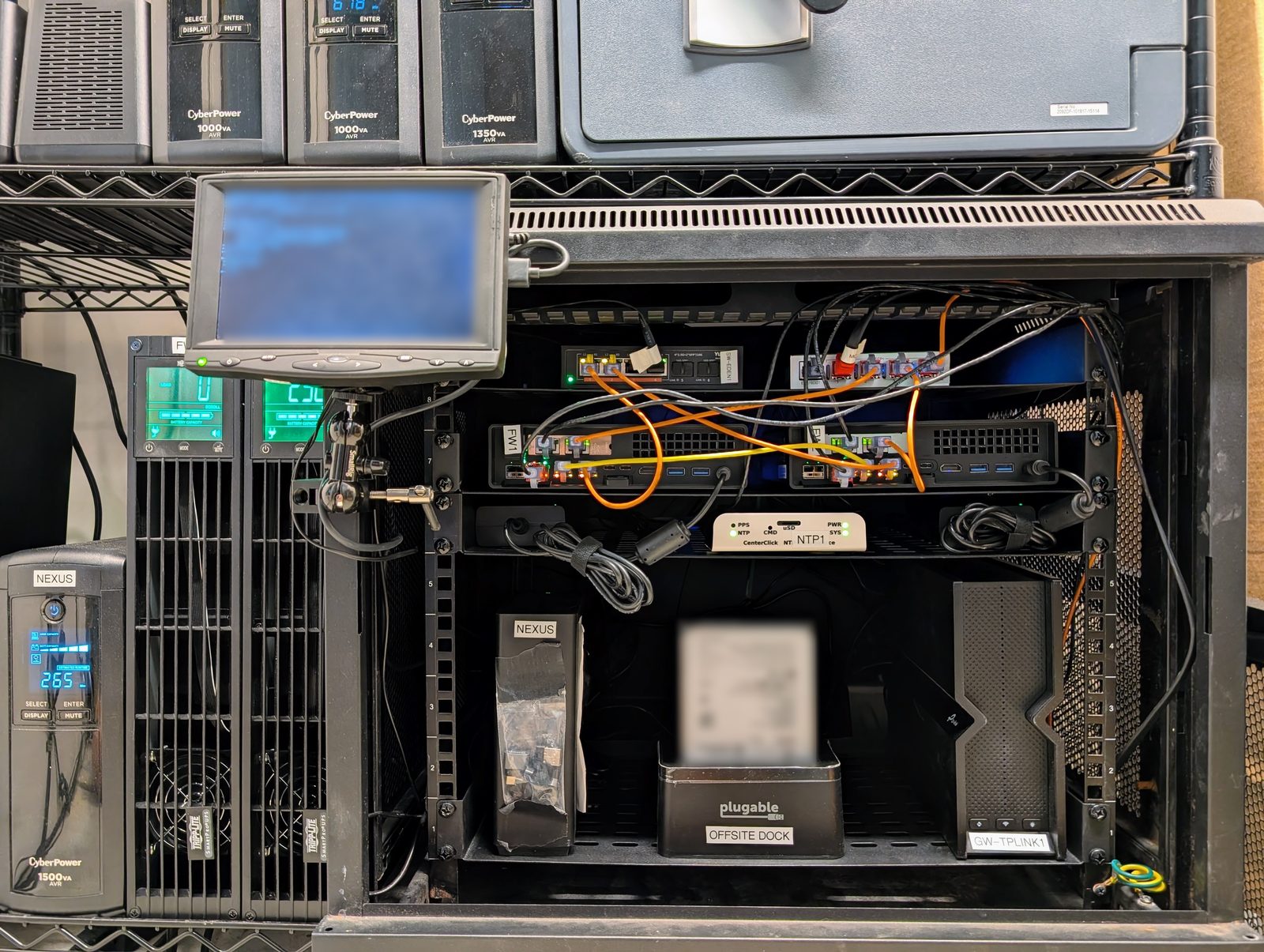
The boundary is the one layer where a mistake takes the whole site off the air rather than one service. That makes it the first place to buy redundancy, ahead of any storage or compute tier. On Node0 the redundancy is a pair: fw1 and fw2, two Minisforum MS-01 small-form machines running OPNsense, active and passive, sharing their addresses through CARP. CARP is the Common Address Redundancy Protocol, which lets two machines share a floating address and a virtual hardware identity, so one takes over from the other without anything upstream noticing.
The pair was proven in a lab on sandbox1 on 20260817, before it touched production wiring. That lab is where OPNsense’s resistance to being managed like a NixOS host was worked through: config edits that fail to hot-reload without reporting it, an API that never syncs a change to the peer, a root shell that is csh. The lab also measured failover as close to free, at zero packet loss across a live major-version upgrade.
Two floating addresses sit on top of the pair, and both move to whichever firewall is master. One carries every public web service, through HAProxy on the firewalls to an internal reverse proxy. The second carries paging notifications only.
The pair also serves DHCP for the household network in hot standby using Kea, and it routes the Node0 VLANs once the fabric hands them over. The retired household router is still racked and powered as a fallback on its own long-established provider binding, and it is planned to leave the rack.
The fibre is terminated by the provider’s own optical network terminal, wall-mounted rather than racked, handing off at 10 gigabit into the fabric’s first switch. It is the provider’s device on the provider’s terms, and it is not in the inventory as a Node0 host.
Outside all of it sits outpost1, a small rented Hetzner cloud VM in Germany that holds no Node0 credential of any kind. It is the only vantage point that sees Node0’s public surface the way the internet does. A core host reaches out to it on a schedule, scans Node0’s public address range from there, and alarms inside Node0 on anything reachable that should not be. Each scan first proves it can see a known reference host, so a broken scanner and a clean perimeter cannot be confused.
| host | role | form | where | OS |
|---|---|---|---|---|
| fw1 | firewall, CARP master on the capture day | small-form desktop | rack0, the edge rack | OPNsense, current release |
| fw2 | firewall, CARP backup | small-form desktop | rack0, the edge rack | OPNsense, current release |
| gw-tplink1 | retired household router, kept as a fallback path | consumer WiFi router | rack0, the edge rack | vendor firmware |
| outpost1 | external vantage point, holds no credential | Hetzner cloud instance | offsite, Germany | Debian |
The Seed’s rung 6 is this layer at its smallest: one dedicated firewall rather than a pair.
The decisions #
20260817: both firewalls in at once, with the old router left untouched #
Workload. Replacing a consumer router that could not be demoted, on a live household connection. Requirement. A pair that fails over, with no window where the home has no internet. Choice. Both machines in at once on the standard configuration, no hardware-address spoofing, and the old router left powered on its established provider binding. Accepted trade-off. A rack position and a little power on a router nobody uses, against a fallback that needs no rebuild. Verified. In the lab, and again three days later, when the cutover hit an unpredicted fault and the fallback carried the home.
20260820: CARP on the internet-facing side becomes the production design #
Workload. Carrying Node0’s public identity across a firewall failover. Requirement. An address that moves between chassis without anything upstream having to relearn it. Choice. CARP on the internet-facing side, after the provider rebuilt the circuit as a plain layer 2 handoff with its address-to-hardware binding removed. Accepted trade-off. The design depends on the provider keeping that handoff plain. An alternative that avoids CARP on that side is written up and kept unused as the fallback. Verified. On the wire on 20260820, by moving a floating address between chassis and watching outbound traffic survive it. An abrupt uplink loss failed over in 4.1 seconds with every packet replied to, and a full chassis reboot did the same.
20260906: the paging path gets its own public address #
Workload. Alerting a human when something inside Node0 has failed. Requirement. The alert path must not share a failure with the thing most likely to be failing. Choice. A second floating address for notifications only, and the reverse proxy added to the pair’s synchronised configuration list. Accepted trade-off. One more public address to hold and watch, against an alert path that survives the loss of the web path. Verified. The notification path has since run through service-layer incidents without going dark with them.
20260911: remote access moves onto the firewalls #
Workload. Reaching the site from anywhere, for Christoph and for the agents. Requirement. Remote access must not depend on a storage host. A maintenance window on one storage host took internal name resolution down fleet-wide on 20260905. Choice. Terminate the self-hosted mesh on both firewalls independently, with no shared state and no dependency on which is master. Accepted trade-off. Two terminations to keep in step rather than one, against a remote path that inherits nothing else’s failover behaviour. Verified. In the lab first, where the design found one of its own assumptions wrong and corrected it before it shipped. The cutover completed on 20260911.
Not yet: a second way out #
Three answers to the single-fibre problem are designed and none are built: a second provider with its own routing, an independently announced address range, and a satellite tier for the day the whole valley loses its one egress. The blocker is money. Until then the fibre and its terminal are single points of failure the pair does nothing about. CARP protects against a firewall dying, not against the circuit dying.
What it cost #
Replacement costs are not yet researched, and purchase prices are not published; the external vantage point is a rental, not a capital item.
What broke #
- Lesson 4.1 , CARP split-brain that was two bad cables, not bad config (20260817): both firewalls claimed master on two of three groups, and the authentication counters pointed at a key mismatch. The fault was a failing cable and an unmanaged lab switch mishandling CARP’s multicast.
- Lesson 4.2 , the two-day diagnosis of a CARP virtual-hardware-address fault on the provider’s circuit (20260818 to 20260820): the provider’s edge equipment bound each public address to the first hardware address that spoke from it and never relearned a virtual one. Failover worked everywhere except where it counted.
- Lesson 4.3 , The admin login page open to the internet (20260820): an address renumber left filter rules written for a service that had moved. The firewall’s own login page became reachable from anywhere for an unrecorded time, and it was closed about ten minutes after it was seen. Luck found it, not monitoring.
- Lesson 4.4 , Kea DHCP high availability: five defects before it actually failed over (20260817 lab, 20260827 production): five defects in a row, each leaving a pair that called itself enabled and would not have failed over.
- Lesson 4.7 , The Intel chip that eats its own DHCP replies (20260828): one of two otherwise identical onboard ports drops every outbound DHCP reply below the driver, invisible to the packet filter and to a capture on the machine itself.
- Lesson 4.13 , Remote access on a storage box (20260905 to 20260911): the mesh’s subnet routing had accumulated on a storage server, and a maintenance window on it took internal DNS down fleet-wide. The routing moved onto both firewalls, per node, after a lab test proved the failover assumption wrong.
- Lesson 2.21 , You cannot see your own front door from inside your own home (20260820 to 20260907): from inside the perimeter, a correctly silenced public address and a wide open one look identical. That is the structural reason the external vantage point exists.
State on the day #
The layer was healthy on 20260920, verified live rather than read from documentation. Firewall fw1 held all nine CARP groups as master and fw2 held none, which is the intended split. Both firewalls ran the same release, rolled in production on 20260917 at a cost of one lost ping in eighteen minutes. The external vantage point answered with 30 days of uptime and zero failed system units, and the metric that depends on it was green.
Open by budget rather than design: the second provider, its routing, the satellite tier.
One fault is known and accepted rather than open. A change applied through the API to one firewall does not sync to its peer, and a gated five-minute job is the only thing closing that gap. Narrowing a binding to fix an exposure broke that sync once already, on 20260821, with nothing reporting it. The current state has one piece of hardware history behind it. An add-in network card in fw2 was replaced on 20260910 after repeated port drops. Nothing in this layer opened or closed on the capture day itself.
Source: node0 as-built v0.1, section 3.2. Sanitized: checklist v0.1, 20260921. Capture of 20260920; the private site keeps changing, this page does not. Part of oznog.com/node0.