Bootstrap
The services that must exist before anything else comes up: names, time, power signals, secrets, and a way to rebuild a host.
3 resolvers, 3 platforms · 3 NTP sources, 1 GPS · 3-member vault
What this layer is for #
Bootstrap is what has to work before any other part of Node0 can come up on its own. A name resolves, a clock agrees with every other clock, a host learns its power has gone away, a machine fetches a secret nobody typed in for it, and a machine that lost its disk gets rebuilt without anyone remembering how.
Every other layer leans on this one, and this one leans on almost nothing above it. Christoph settled the boundary while placing the long-running monitoring agent, with one question. Is this thing part of the bootstrap layer, or a consumer of it?
Two kinds of thing answer yes: whatever must exist before anything else works, and whatever must survive the failure of the layer it sits on. On Node0 that is the firewalls, the secondary nameservers, core1 and the console attachment. Everything else is a workload and can virtualize. This layer, mostly, cannot. It did not arrive as a plan. It accreted, each time Node0 found the same failure twice.
How it is built #
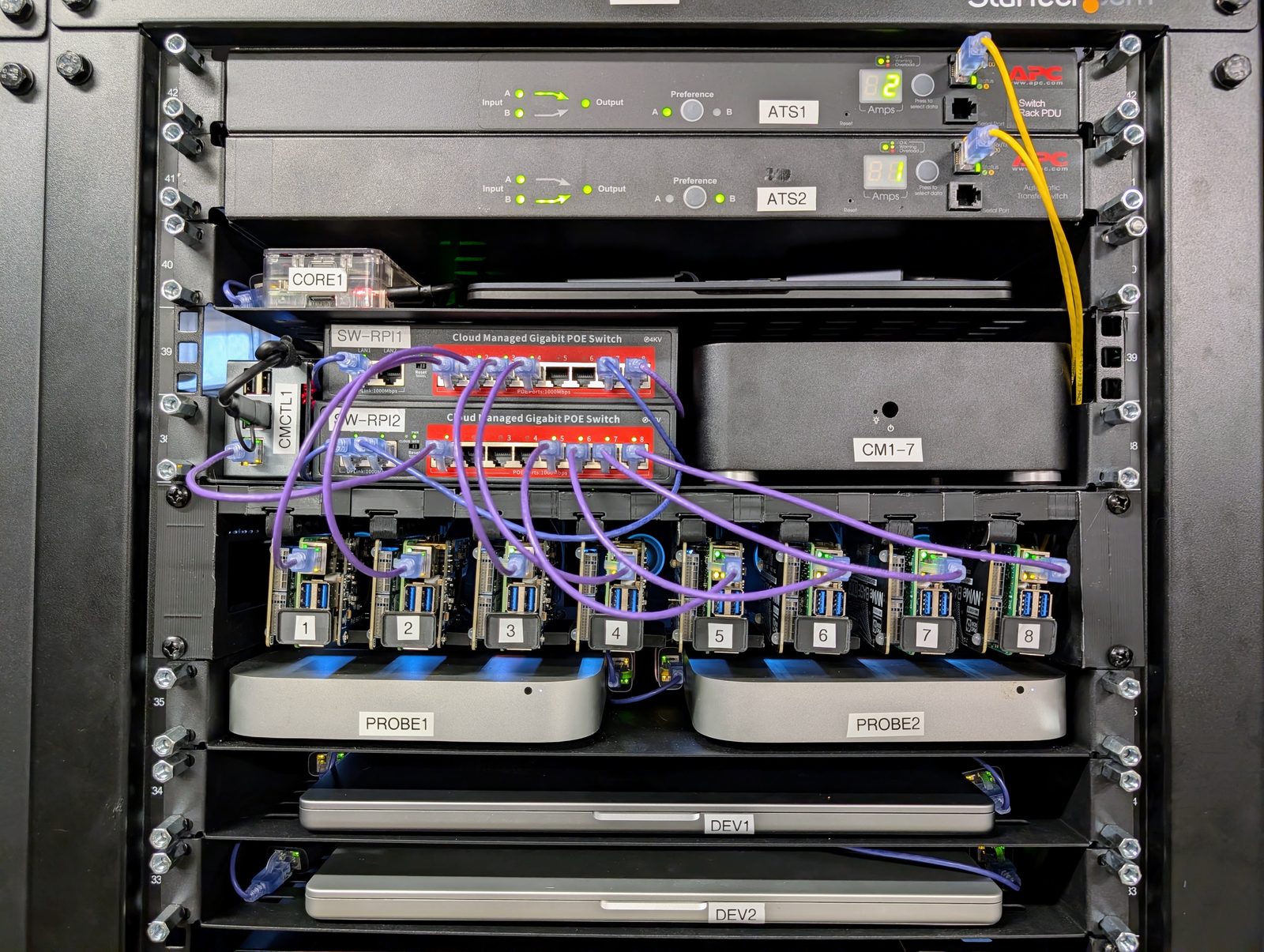
What must exist before anything else can be trusted gets its own small hardware, and the small box that never reboots is the primary. On Node0 those boxes are core1, a Raspberry Pi 4B, and core2, a small x86 laptop. Between them they carry a secondary nameserver each, one of the three time sources, both power-event daemons and one vault member, and no workload at all. One service breaks the rule. The editable DNS primary is a container on the storage hub, and the failure domain below says what that costs.
Names. Three Technitium DNS servers run on three platforms, clustered so that blocklists and policy replicate between them automatically. Zone data moves on its own path, by signed transfer from the one editable primary. That primary is ns1, a container on the storage hub. The secondaries are ns2 on core1 and ns3 on core2.
Time. Three sources serve the site. ntp1 is a GPS-disciplined appliance and the site’s one independent hardware clock. ntp2 is a chrony container on the storage hub. ntp3 runs on core1, with public servers as the fallback. Every host carries all three resolvers. Every host also carries its NTP servers by address rather than by name, so a cold boot needs neither DNS nor the internet to find the time. ntp1 was an anchor on paper for most of a year, because its clients were right to refuse a source that reported multi-second uncertainty about itself. An external GPS antenna fixed reception on 20260910.
Power signals. Two NUT servers run on core1 and core2, polling the same four UPS cards. NUT is Network UPS Tools, the daemon that reads a UPS and tells hosts when to shut down. core1 holds the shutdown authority. core2 adds notification and a second observer, and is deliberately not a failover.
Secrets. A three-member OpenBao vault spans three failure domains, with no member on the clustered storage tier. The members are joined by raft, a consensus protocol that keeps one agreed copy of the data across them. The vault unseals itself, so that after a full-site power loss the cluster can reform with nobody present and a machine can fetch what it needs unaided. That is the intent; the power-return rehearsal that would prove it end to end has not been run (power ).
Rebuilding a machine. One build host, di5, rebuilds any NixOS machine from
the flake, including one with no disk yet. util2 is the fallback builder, and
also holds the nix cache and the network-boot server. Hosts converge to a
deploy git ref on their own schedule rather than being pushed to, so a host
that was off during a change window catches up unattended. Machines with no
out-of-band management reach a console through kvm1, a PiKVM riding the
sixteen-port switch console1. A printed bring-up card covers the case where
even the agent is away.
Out-of-band management #
Every server’s management controller (the BMC, the small computer inside a server that stays up on standby power), every switch’s management port, the UPS, strip and transfer-switch cards and the PiKVM sit on the management segment, on the management switch, each on its own access port and never on the host’s bond. So nothing done to an operating system, a bond or a switch pair can take remote power or a console away, and that was confirmed rather than assumed. Two GPU hosts are the exception: their controller shares a network port with the host and answers reliably only while the host is down. Three more have no controller at all and use the PiKVM.
What the pulled boards taught, in the form a builder can use. They are AMI controllers on Supermicro X10 boards; other vendors differ in detail and rarely in kind.
- Read a boot override back before you trust it. Set while the controller is still settling after a power change, it returns an error and is not applied, and the host boots whatever its firmware remembers. The override flipping back after the boot is the proof it was honoured.
- A graceful shutdown does nothing on a machine with no operating system. It is an ACPI request, and something has to be listening. Use a hard off while a box is bare or sitting in an installer, and retest the graceful path once there is an OS to answer.
- Redfish power and thermal are stubs on unlicensed boards. They reported
18 W and every fan at 0 RPM while the machine was running at over 9,000 RPM,
which reads exactly like a failed power-on. The power state is correct; the
sensors are not. Read sensors over IPMI (
ipmitool sdr), and never wire an alert to Redfish thermal on these boards. - Set the controller’s hostname before its static address, or the address silently reverts, and finish with a controller cold reset.
- A power-off resets the fan mode to full. Any custom fan floor has to be re-asserted by a boot-time unit on the host, with a read-back, and zone writes issued back-to-back are dropped, so pace them a few seconds apart.
- No virtual media without the vendor licence. Network boot is the only remote install path, so the network-boot server comes before the first box.
- Power restore policy: power on, and check the enum per board family. “Previous” sounds right and is a trap: a clean shutdown leaves a server in soft-off, and “previous” then restores off, so the fleet came back dark after its own orderly shutdown (lesson 5.11 ). Every server is set to power on when mains returns, and the return order is the shutdown design’s job. On these boards the BIOS value that means “power on” differs by board family, and the setting reads back as the old value until the next boot, so a real reboot is the only proof, and that proof is still pending on part of the fleet. It is accepted until the power-outage rehearsal, which needs a planned whole-site outage.
- Outlet control on the strip is the fallback for a wedged controller, and only that. Cutting the outlet also cuts the controller’s standby power, so a machine whose outlet is off cannot be woken remotely until the outlet is back.
- A controller password never goes on a command line, where it lands in shell history and every process listing. Node0 learned that one the hard way, and it is one of the four lessons kept back.
Open on the capture day: two controllers refuse Redfish with credentials that IPMI accepts, uncosted, on hosts outside the paging path.
| host | role | form | rack | OS or firmware |
|---|---|---|---|---|
| core1 | secondary DNS, NTP, NUT with shutdown authority | Raspberry Pi 4B | rack 2 | Debian 13 |
| core2 | secondary DNS, NUT observer, vault member | small x86 laptop | rack 2 | NixOS 26.05 |
| ntp1 | stratum-1 GPS time source | NTP appliance | rack 0 | appliance firmware |
| util2 | nix cache, network boot, fallback builder | small desktop | rack 3 | NixOS 26.05 |
| kvm1 | remote head onto console1 | PiKVM | rack 2 | Arch Linux ARM |
| console1 | sixteen-port HDMI and USB console switch | 1U KVM | rack 2 | appliance |
| openbao3 | third vault member | NixOS guest on a hypervisor | rack 2 (its host) | NixOS 26.05 |
Failure domain. Losing the hub takes the only zone-editable primary with it. Both secondaries keep answering every query, and go stale only if the hub stays down past a settings change. Losing one DNS or NTP box changes nothing observable. Losing two of the three vault members stops reads and writes, though consumers keep the secret they already rendered. Losing both builders stops the fleet rebuilding itself, and what already runs keeps running.
The Seed reaches this layer at rung 3 : one small core box takes the DNS and time primaries and sends the alerts, so the main box can fail without taking names and time with it.
The decisions #
20260817 to 20260819: three resolvers, three platforms #
Workload. Every name in the site, served by one AdGuard instance until 20260817.
Requirement. DNS survives a reboot of any single machine, including the hub that used to own it.
Choice. A Technitium cluster with one editable primary and two secondaries. ns2 runs on core1, a Raspberry Pi that boots from a card, so its recovery story is “reinstall, point it at the primary, walk away”. ns3 runs on core2, which is x86 where core1 is ARM, so one bad image cannot take both secondaries.
Accepted trade-off. Three upgrade paths to keep in step, and zone edits possible in only one place.
Verified. During the primary’s outage of 20260920 both secondaries answered every query, with no fleet-wide impact.
20260911: re-initialize the vault, three members, unattended unseal #
Workload. Machine-fetched secrets for the fleet.
Requirement. A full-site power loss must not leave the site waiting for a person to type something in, and the vault must not depend on the storage tier it helps bring up.
Choice. Retire the earlier instance rather than migrate it, since it held no production secret. Stand up three members on three platforms, none on the clustered storage tier, unsealing unattended rather than on key shares presented by a human. Boot-critical and outage-critical secrets, the ones needed to bring the site back when the vault is not there, stay outside it in the encrypted secrets file.
Accepted trade-off. A vault that unseals itself is one an attacker holding the hardware can unseal too, so the protection moves to physical access.
Verified. Brought up and sealed the same evening, initialized the next day, and healthy at the capture.
20260829 and 20260910: one build host, one sanctioned rescue path #
Workload. Building configurations for 29 NixOS hosts, and recovering one that will not boot.
Requirement. Any machine rebuilds from the repository, and remote recovery has one method known to work.
Choice. util2 became the build host on 20260829, and the faster di5 took over on 20260910 with util2 kept as cache, network boot and fallback. Never boot a rescue image by loading a kernel from the running one, because the load can hang the machine with nothing left to read. Use a one-shot boot-manager entry with automatic fallback instead.
Accepted trade-off. Two machines to keep current, and a rescue method that needs the machine to actually reboot.
Verified. The rescue rule was formalized after the older method hung a laptop twice with zero diagnostics (20260829). Since 20260918 pull-deploy has compared the resolved commit against the branch head, failing closed.
20260920: pin the image, never a floating tag #
Workload. The clustered resolver, and any clustered service run as a container.
Requirement. No unattended process moves one member’s version out from under the rest.
Choice. Pin the image by exact tag rather than latest. Coordinate parity
inside one maintenance window, with members restarted one at a time.
Accepted trade-off. Upgrades become a scheduled act, and one member stays behind until the distribution ships the matching version.
Verified. Decided the same day the skew was found and fixed (20260920). The gap on the third member was still open at the capture.
What it cost #
Replacement costs are not yet researched, and purchase prices are not published.
What broke #
- Lesson 4.15 , A resolver that lied by omission: healthy on every check while replication silently stopped. An unattended image pull recreated the DNS primary with a dormant permission setting. The newer primary that came back could no longer replicate configuration to the older secondaries, and every signal being watched said “healthy”.
- Lesson 4.12 , Zone transfers need a shared key, not just a source-address rule. A secondary sometimes asked for a zone from a different one of its own addresses than the primary’s allow-list expected. Transfers failed until authorization moved to a key on 20260818.
- Lesson 6.10 , A failed fetch still exits zero, and “already converged” can mean “still stale”. The build tool fell back to its local cache when it could not reach the repository. It warned quietly and exited zero, and the layers above read that as a real convergence.
- Lesson 1.15 , Half a KVM stopped taking keystrokes, and the fix is a new KVM. One bank of the console switch stopped forwarding keyboard input while video kept working. That left eight hosts with a console you can watch but not type into.
State on the day #
Healthy on 20260920: DNS, NTP and the two NUT servers, all four on the as-built’s stable list. Both core hosts had selected ntp1 as their stratum-1 reference, checked live during the capture. The vault cluster was live. pull-deploy was converging and failing closed.
Open at the capture of 20260920: the vault’s full deployment, with the cluster running and the secrets not yet moved into it. The version gap on the third resolver is held back until the distribution ships the matching version. The console switch’s dead bank has been open since 20260918, its hosts moved to the surviving bank with one port kept as a manual bypass, and Christoph’s verdict is that this model will be replaced when funds allow.
Closed on the capture day itself: the resolver outage and the replication failure behind it. One secondary was brought up to the primary’s version, and replication restarted. A stale “last synced” timestamp updated the moment the versions matched, which is the proof.
Source: node0 as-built v0.1, section 3.4. Sanitized: checklist v0.1, 20260921; voice pass 20260921. Capture of 20260920; the private site keeps changing, this page does not. Part of oznog.com/node0.