
Agents and dev
The machines the agents and the developers run on, the sandboxes the agents are allowed to break, and the rules that say what an agent may change without asking.
six agent machines · 2,069 commits, 11 by a human · one key per agent
What this layer is for #
Node0 is operated by agents, not only for them. Its founding principle is agent-forward, human-sovereign operation. Digital intelligences (DIs, this site’s term for its AI agents) do the deployment, monitoring, diagnosis, repair and documentation. Christoph keeps sovereignty through readable interfaces, exact approval of the operations that matter, and the ability to run the foundation himself if the agents go away. This layer is the machines the sessions run on, and the rules that keep every agent’s actions its own and every agent revocable.
The claim is checkable in one place. The Node0 repository opened on 20260810 and held 2,069 commits on 20260921 (git log, 20260921): 1,834 by the agent Rigger, 163 by Bosun under two spellings of its name, 27 by a generic Claude identity, 34 by two unattended jobs, and 11 by Christoph. He decides, the agents do essentially all of the typing, and the commit author field is the record of who did what.
How it is built #
| host | role | form | rack | OS |
|---|---|---|---|---|
| agent1 | agent host | MacBook Pro M1 Max, 64 GB | rack 3 shelf | macOS |
| agent2 | agent host | MacBook Pro M1 Max, 64 GB | rack 3 shelf | macOS |
| agent3 | agent host | Mac mini M4 | rack 3 shelf | macOS |
| agent4 | agent host | Mac mini M4 | rack 3 shelf | macOS |
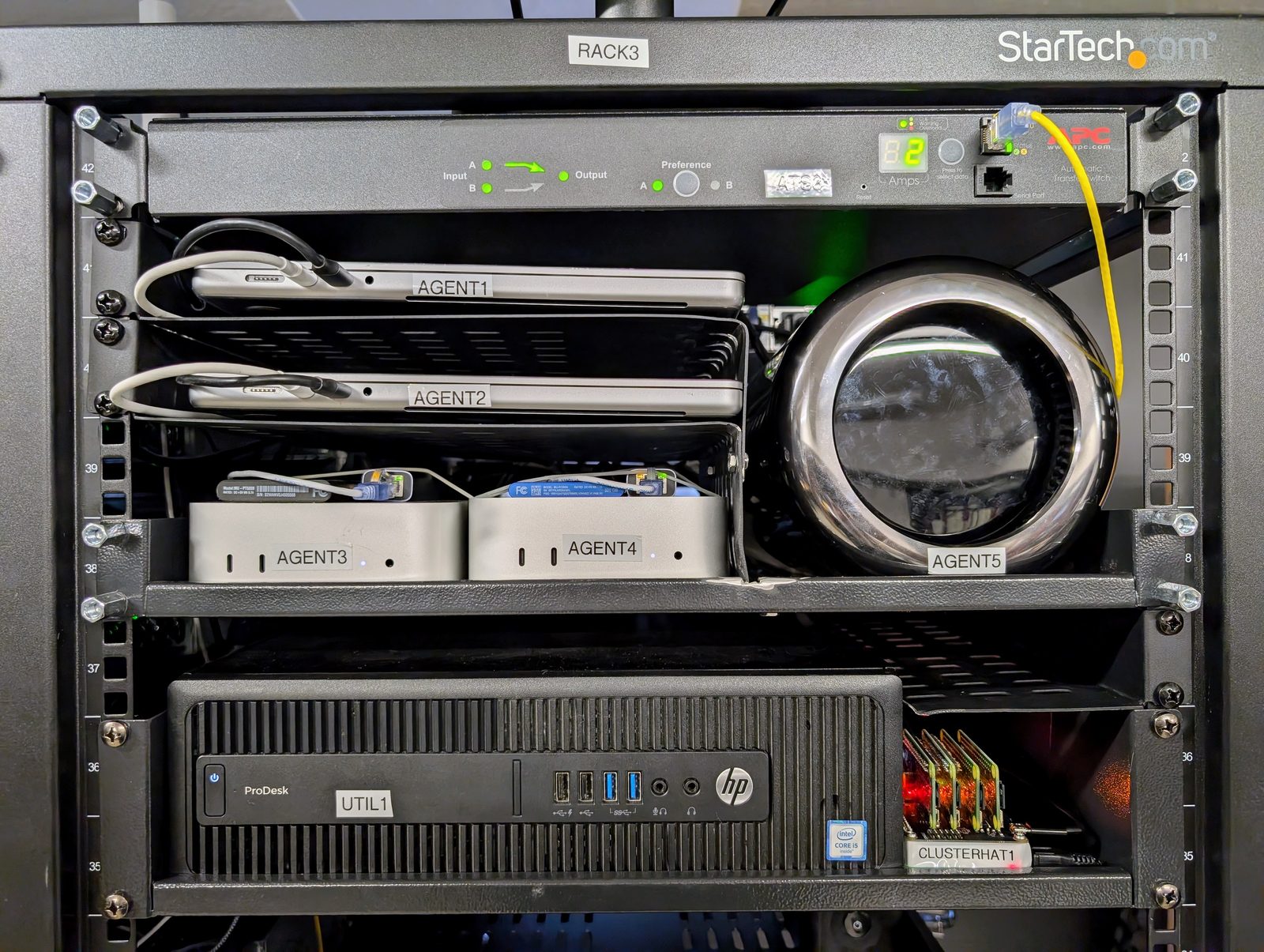
| agent5 | agent host | Mac Pro 2013, 12-core | rack 3 shelf | NixOS |
| agent6 | agent host | virtual machine, 4 vCPU / 16 GB | Proxmox cluster | NixOS |
| dev1 | dev host | MacBook Pro M1 Max, 64 GB | rack 2 | macOS |
| dev2 | dev host | MacBook Pro M1 Max, 64 GB | rack 2 | macOS |
| dev3 | dev host | Dell OptiPlex 5050 | rack 2 | NixOS |
| dev4 | dev host | HP EliteDesk 800 G3 | rack 2 | NixOS |
| sandbox1 | sandbox | MacBook Pro 2018 (T2) | rack 3 | NixOS |
| sandbox2 | sandbox | HP ProBook 6570b | rack 3 | NixOS |
The roster started as laptops: M1 Max MacBook Pros, chosen for their processing capacity and because 64 GB of memory came at a reasonable cost against the alternatives, and four of them are agent1, agent2, dev1 and dev2. agent3 and agent4 arrived as Mac minis on 20260818. agent5, a salvaged 2013 Mac Pro converted to NixOS on 20260830, is left unused on purpose, since a machine does not earn its power draw by being available. agent6 is the only virtual one, and it runs Bosun, the agent that operates the site day to day. The dev hosts carry development sessions and, on the NixOS pair, continuous integration. Forgejo Actions runners went onto dev3, dev4 and sandbox1 by benchmark on 20260831, and onto dev2 by hand, because a macOS build needs a macOS runner. sandbox1, installed on 20260815, was the first host of the current NixOS fleet (NixOS had run on earlier machines in January 2026), and it was wiped and rebuilt from committed configuration alone on 20260816. The rebuild was checked against a closure hash (the identity of the exact package and configuration set a NixOS system resolves to) taken before the disk was touched, and every later NixOS host here inherited that.
The four dev hosts are where applications get built, as distinct from where the site gets operated. They carry the development of the projects that run on Node0 and are incubated by Oznog, Relational Core first, and later the projects of the incubator . A project gets its development sessions on a dev host, the site’s local models through the gateway, the storage tiers, and the CI runners on the same shelf, so it is built on the infrastructure it will run on rather than ported to it later. The two Macs cover the work that needs macOS; the two small NixOS boxes cover the rest and run the runners.
The two sandboxes are on this shelf because they are the agents’ rehearsal machines, and an agent fleet needs them more than a human team does. An agent operating something for the first time builds it on a sandbox first, breaks it on purpose, writes down what it found, and only then goes near live hardware; the storage cluster, the firewall pair and the remote-access design were each proven and corrected there before they touched anything real. Two old laptops that nothing depends on are the cheapest insurance on the site, and old is fine: sandbox2 is a 2012-era business laptop, and it had the capacity to model the whole hypervisor and storage cluster deployment as a set of virtual machines before any real hardware was tested, with room to spare. Lesson 6.18 carries the instances and the rule.
herdr , a fleet session manager, carries session state and is pinned to one version across the NixOS hosts. A mirror plugin on Christoph’s own machines gives him one sidebar onto every session. Claude Code and Codex are the runtimes, both pinned to upstream releases rather than to the distribution’s packaging, which had drifted 53 patch versions behind when this was noticed.
The Seed starts this layer at rung 2 , where the agent gets a box of its own, and its design keeps a sandbox the agents can break .
The decisions #
20260811: one key per agent #
Workload. Every DI that touches a fleet host, over ssh and over service APIs. Requirement. Attribution and revocation per agent, without spending bring-up on privilege boundaries for a fleet whose shape was not yet known. Choice. For bring-up, one shared operating-system account for the agents, with a distinct credential per agent landing in it. Bosun is named as an independent operator under Christoph’s direct authority, distinct from Rigger, the commissioning lead. Accepted trade-off. Agents that share an account share its reach, taken for deployment throughput during bring-up. The direction is short-lived credentials scoped to the job and issued by the secrets vault; lesson 6.1 carries why agents at scale need identity issued by a program. Verified. The commit log separates the two agents from the first week onward.
20260917: the operating agent moves in-fabric #
Workload. Bosun’s monitoring and remediation session, run from Christoph’s laptop since the beginning. Requirement. Hands that survive a closed lid and an absent person. Choice. A NixOS guest, agent6, on the Proxmox cluster, under twelve decisions accepted the same evening. The substantive ones are an ssh key generated on the guest rather than copied to it, per-service credentials of its own wherever it touches a service, no out-of-band device passwords on the guest, an independent clone of the repository, and a heartbeat to a dead-man on another host. Accepted trade-off. A cluster outage takes agent6 and with it Bosun, accepted because Bosun’s job in a cluster-wide outage is to have already paged, not to fix it. Verified. Deployed 20260917 into 20260918; on 20260920 the guest reported about two days seventeen hours of uptime, with its session process and timers checked live.
20260920: the standing authority boundary #
An agent’s standing authority is two written lists: what it may change unaided, and what needs the person.
Workload. Everything Bosun does between messages from Christoph. Requirement. An agent useful enough to close real problems alone, without one that can take the site down alone. Choice. Those two lists, each row justified by the incident that set it, drafted from the first three days on agent6 and revised by Christoph; three of those incidents are lessons below, and the cost is latency where latency is cheapest.
Without asking, Bosun may run read-only queries anywhere; edit inventory records, which are reversible by object identifier and seeded from the repository; change alert rules, thresholds and labels with tests, and change dashboards through the generator, because a bad rule is noise rather than an outage; commit and push runbooks and tools after rebasing; set a silence with a stated reason and an expiry of at most seven days; restart and re-time its own monitors on its own host; make edits that stay dormant until a container is recreated, when it reports the landing time; and apply a fix found on one host to the rest of that class, after a read-only check confirms it.
Bosun asks first before rebooting or power-cycling any host, however harmless it looks; deleting anything it did not itself create in the same task, including files, records, containers and snapshots, so cleaning up its own working files and test objects is inside its authority and nothing else is; promoting the deploy branch, which converges every host at once; changing the version of a resolver, a firewall, or anything on the paging path; creating, rotating or deleting credentials on a shared service; anything physical; restarting a firewall or moving the edge; touching another host’s secrets; silences longer than seven days, or any silence on a scarred drive; anything inside another agent’s domain; and building something because a gap seems to exist, without first searching for what may already close it.
What it cost #
Replacement costs are not yet researched, and purchase prices are not published.
What broke #
- Lesson 6.2 , Imperative drift on NixOS evaporates silently. An out-of-band change succeeds and then vanishes at the next rebuild, which is worse than a refusal because it looks like success.
- Lesson 6.11 , Two agents, one git index. One agent’s commit swept up seventeen files another had staged, with no error on either side; the real fix is a worktree per agent.
- Lesson 6.14 , The heartbeat that was not watching what mattered. It proved the guest was up, not that the session inside it was alive and logged in; writing the operating runbook found that, not an outage.
- Lesson 6.15 , A second AI, forked from the first one’s memory, that could not find it. A 178-file agent memory was migrated to the new host while the session read a different, empty path, so the agent worked without its own history and nothing errored.
State on the day #
Healthy on 20260920: twelve hosts active, none retired; four CI runners registered; Bosun three days into running on agent6, checked live by host name, uptime, its session process and its timers.
Open: sandbox1 has a pattern of spontaneous power-offs at five-day intervals, most likely tied to running Linux on a machine with Apple’s T2 controller and everything that brings with it; under diagnosis and mitigation, and recorded so far in lesson 1.16 .
Closed on the capture day, marked as such: the memory-path mismatch was fixed, and the heartbeat given gates that make it refuse to beat unless the session process is present and its login still valid. The as-built capture, written earlier that day, still lists that gap as open; the next capture settles it.
That evening also produced the operation that best shows what the arrangement is for. An audit asked of the hypervisor’s backup server how old the newest archive was, per source, rather than whether the jobs were green. There were no jobs. The datastore held one archive from a restore test of 20260904, and five production guests had never had a disk-level backup. Nothing said so, because every existing check looked at the backup server’s own housekeeping, and a prune job with nothing to prune succeeds. Bosun closed it the same evening. One cluster-wide job runs at 04:45 nightly in snapshot mode, covering every guest but the two test ones, so a new guest is covered the day it exists, with retention held on the backup server. Bosun ran the job by hand rather than waiting for it, and wrote six alert rules that page if it disappears or if a guest’s newest archive passes thirty hours. One production guest’s archive was restored to a scratch virtual machine, booted in isolation to a login prompt with its database up, then destroyed. The question that would have caught this a fortnight earlier is now in the backup runbook.
An agent found the gap, built the job, ran it, wrote the alarm, proved the restore and cleaned up, in one evening, inside a boundary that would have made it ask before deleting anything it had not made.
Source: node0 as-built v0.1, section 3.8. Sanitized: checklist v0.1, 20260921. Capture of 20260920; the private site keeps changing, this page does not. Part of oznog.com/node0.